Do you actually need Kubernetes?
Five rungs, simplest at the bottom. I run all of them in production right now. Climbing too early costs money, climbing too late costs a night.
- Kubernetes
- AWS
- Architecture
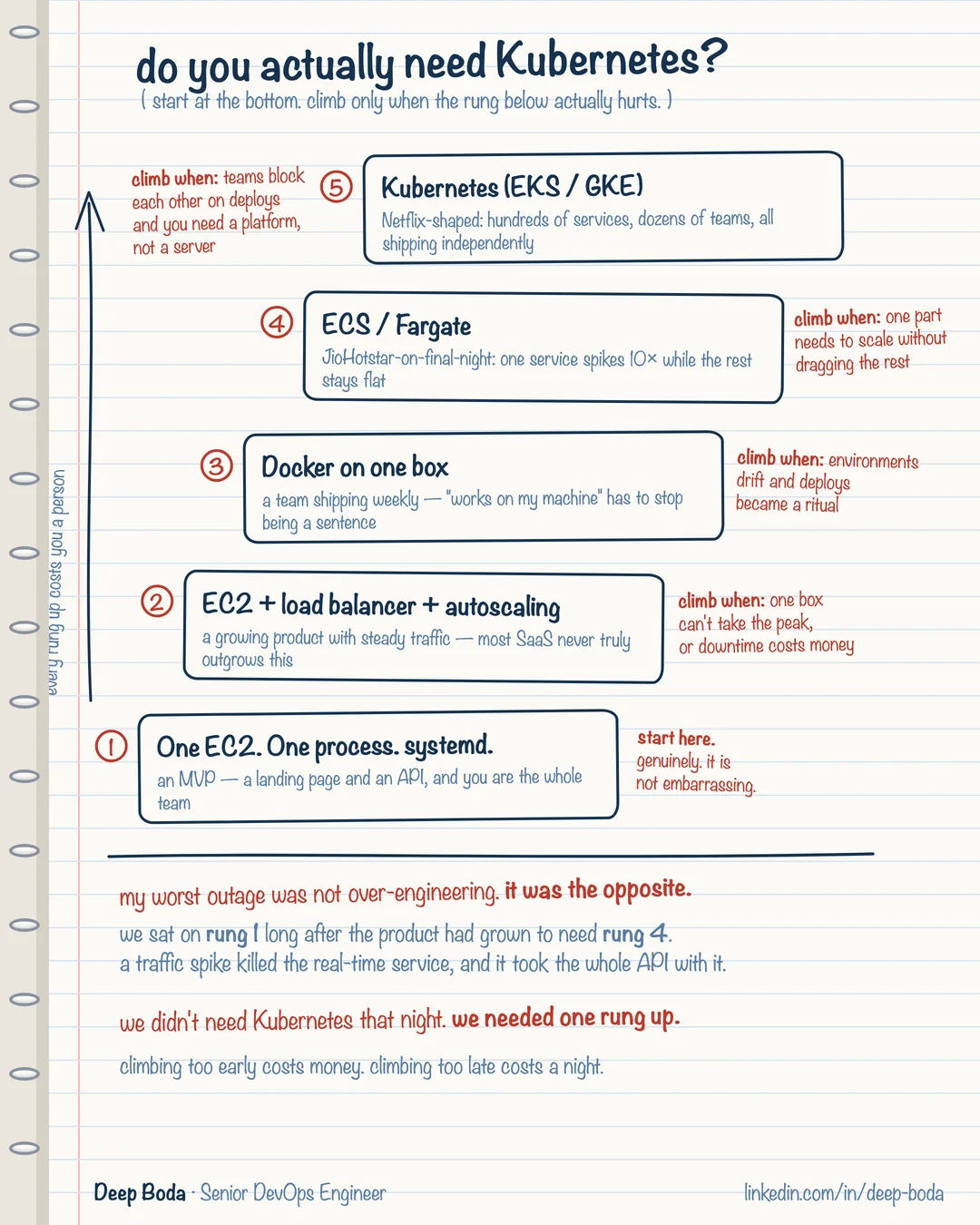
Most teams asking for Kubernetes do not need Kubernetes.
I say that while running EKS in production. And ECS. And a plain EC2 with systemd, all three right now, for different products.
Here is the ladder I actually think in. Five rungs, and the only rule is: climb when the rung below starts hurting, not before.
Rung 1. One EC2, one process, systemd
An MVP, a landing page and an API, and you are the whole team. Start here. Genuinely. It is not embarrassing.
Rung 2. Add a load balancer and autoscaling
Climb when one box cannot take the peak, or when downtime starts costing money. Boring, cheap, and most SaaS never truly outgrows it.
Rung 3. Docker
Climb when environments have drifted and deploys have become a ritual. "Works on my machine" has to stop being a sentence someone can say.
Rung 4. ECS or Fargate
Climb when one part needs to scale without dragging the rest. Think of the shape: one service spikes 10x while everything else stays completely flat.
Rung 5. Kubernetes
Climb when teams are blocking each other on deploys and you need a platform rather than a server.
And know that someone owns that cluster at 2 AM. That someone is a full-time job.
Every rung up costs you a person. That is the real price, not the AWS bill.
Now the part people get backwards.
My worst outage was not caused by over-engineering. It was the opposite. We sat on rung 1 long after the product had grown to need rung 4. A traffic spike killed the real-time service and it took the whole API down with it.
We did not need Kubernetes that night. We needed one rung up.
Climbing too early costs money. Climbing too late costs you a night.