You don't have backups. You have files.
Everyone asks whether you have backups. Almost nobody asks how long a restore takes, and only one of those questions matters at 3 AM.
- Reliability
- Disaster Recovery
- AWS
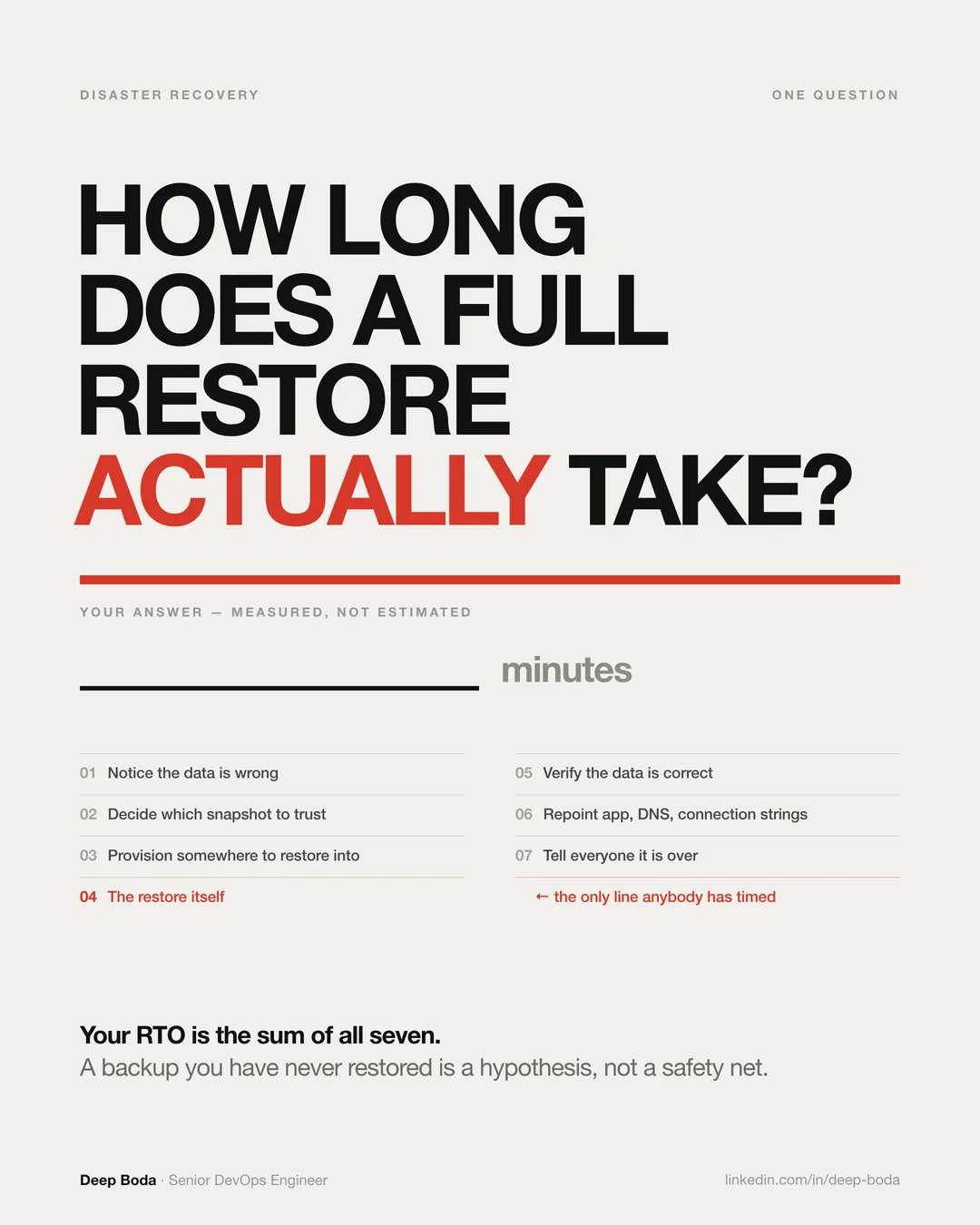
Everyone asks whether you have backups. Almost nobody asks how long a restore takes.
Those are completely different questions, and only one of them matters at 3 AM.
What a restore actually costs
- Notice the data is wrong
- Decide which snapshot to trust
- Provision somewhere to restore into
- The restore itself
- Verify the data is actually correct
- Repoint the app, DNS and connection strings
- Tell everyone it is over
Seven steps. Your RTO is the sum of all seven.
But when teams quote a recovery time, they are almost always quoting step four, the only one the tooling reports. The other six are guesses wearing a number's clothing.
And some of those guesses are large. "Which snapshot" can take longer than the restore itself, because it means working out exactly when the data went bad. Verifying is not a step people plan for at all, and it is the one you cannot skip.
A backup you have never restored is a hypothesis
Not a safety net. A hypothesis.
The fix is unglamorous and takes an afternoon. Pick a calm Tuesday, restore into a throwaway environment, time every step, write the number down. Then tell the client that number instead of a comfortable one.
If someone asked you right now, could you answer with a measurement rather than a feeling?